
For Vijay Menon, a second-year Full-time MBA candidate graduating in May 2026, the journey into venture capital began not with a long-held plan, but with a single formative experience early in his time at Johns Hopkins Carey Business School.
“When I was a first-year student, I competed in [the Venture Capital Investment Competition] and had a second-year teammate, Kyler McGillis[TP1] , who really opened my eyes to the space,” Menon recalls. “Over those few weeks, I fell in love with the job itself.”
That initial exposure quickly evolved into something deeper. Menon describes being drawn to the intellectual breadth and collaborative nature of venture capital work.
“The ambiguous problem-solving across disciplines, being able to chase my intellectual curiosity by having to learn new industries on the fly, working closely with people whose strengths complemented my own,” he says. “Between the work itself and the energy and passion I saw from Kyler, my teammates, and everyone in the industry, I was hooked.”
Inside the Venture Capital Investment Competition
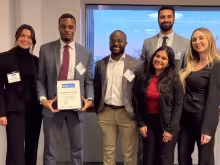
Menon credits much of his early development to the VCIC, a hallmark experiential learning opportunity within the Johns Hopkins ecosystem. Designed to simulate real-world venture investing, the competition challenges students to evaluate startups, conduct due diligence, and defend investment decisions under pressure.
“VCIC was exhilarating,” Menon says. “Weeks of preparation distilled into a single day of performance.”
The intensity begins almost immediately. Teams receive three pitch decks on Wednesday evening to kick off the due diligence phase, and by Friday morning, they have to pick one company to invest in and defend that decision to a panel of career venture capitalists.
Preparation is both rigorous and immersive. Those 36 hours are a whirlwind of activity, with teams spending every available hour researching, building financial models, and putting together strong theses about which company they want to back.
When competition day arrives, the pace only accelerates.
“Game day moves fast, but in the best way,” Menon says. “After a 14-minute window to interview the founders, we got immediate feedback from the judges.”
The final stage is perhaps the most daunting. “We then finalized our investment decision and term sheet before defending it to a panel of 16 career VCs who grilled us and tried to pick apart our logic,” he explains. “The experience really does simulate how millions of dollars get deployed. I enjoyed every minute of it.”
During the competition, Menon and his team chose to invest in a company that stood out for both its mission and scalability. While confidentiality prevents him from sharing specific details, Menon emphasizes the importance of conviction in venture decision-making.
“We chose to invest in a consumer-packaged goods brand,” he says. “Really cool company with a compelling mission, a highly scalable model, and a fantastic founder. It’s the kind of brand that gets people genuinely excited, and our conviction in the team and the market opportunity made for a strong investment thesis,” he notes.
Diving into the venture capital ecosystem
Following his VCIC experience, Menon wasted no time immersing himself more deeply in venture capital and startups across the Johns Hopkins ecosystem.
“Since I first caught the bug competing in VCIC last year, I dove into the ecosystem headfirst,” he says.
Over the summer, he interned with CerraCap Ventures in the Los Angeles area, gaining hands-on experience in early-stage investing. That experience extended beyond the internship itself.
“I’ve continued working with one of their portfolio companies since, which has been a great way to see firsthand what it’s like to operate an early-stage business,” he adds.
Back on campus, Menon participated in the inaugural Venture Strategy Program through Johns Hopkins Technology Ventures, where he felt an immediate impact.
“That was a phenomenal opportunity,” he says. “I was embedded with two Hopkins-affiliated startups coming out of top accelerators in the ecosystem, helping them think through commercialization and growth strategy.”
From student to scout
One of the defining moments in Menon’s journey came through a chance connection during the Venture Strategy Program, which led to an opportunity that aligned perfectly with his growing interests.
“Through that program, a guest speaker named Teddy Gresser connected me with Underdog Labs, a VC firm looking to get more involved in early-stage Hopkins startups,” he explains. “They were looking for a venture scout, I applied, and I got the role,” Menon says.
In that position, he gained rare insight into how investment decisions are made in real time.
“Since then, I’ve had a front-row seat to the deal room, watching how experienced investors discern from a 15-minute pitch which questions to ask, and how they arrive at their investment decisions,” he says.
Seeing both sides of the table
While Menon has developed strong experience as an investor, he has also stepped into the role of a founder—broadening his perspective on venture capital.
“On the founder side, my classmate Andy Charlorin is building something I believe in,” Menon says. “He’s a nurse from Long Island with a great idea and the passion to match.”
After observing the company’s progress, Menon made a pivotal decision. “After watching him develop the business, I joined the team as a co-founder and chief strategy officer,” he explains.
Menon says this dual perspective has proven invaluable, teaching him how to think about venture from the other side of the table and how to grow as both an investor and an operator.
As graduation approaches, Menon remains open to multiple paths—each rooted in his passion for building and investing in innovative companies.
“If our startup launches successfully, I’d love to pursue that full-time,” he says. “If not, a career in venture capital is where I see myself.”
Carey shaped the journey
Menon credits the Carey Business School with providing both the academic foundation and experiential opportunities that enabled his growth.
“Carey’s classes have been a great foundation, especially for someone without a traditional finance background,” he says. “The professors are incredible, and their investment in our growth really shows through the time they set aside for us outside of class.”
Equally important has been the school’s integration with the broader innovation ecosystem. “Carey, leaning into the Hopkins innovation ecosystem from the investor perspective, has brought great exposure to students who haven’t had prior access to the venture scene.”
Menon’s journey reflects the power of hands-on learning, mentorship, and community within the Johns Hopkins ecosystem. From competing in VCIC to working with venture firms and launching a startup, he has embraced every opportunity to explore and grow.
What began as a single competition has evolved into a clear sense of purpose—one shaped by curiosity, collaboration, and a willingness to dive in headfirst.


