

Johns Hopkins Carey Business School is not the average business school, just as Johns Hopkins was not the average businessman.
Johns Hopkins’ mother saw her child’s innate business ability and pushed him to “go where the money is.” After arriving in Baltimore, Johns quickly advanced from store clerk to finance capitalist and, ultimately, bank president.
Before Johns Hopkins was a hospital or a university, Johns was a businessman building for what’s next. Even after he made his fortune, he remained committed to creating lasting value. It was that quest to build for what’s next that drove Johns to create America’s first research university and set a new course for education.
William Polk Carey also saw the chance to create lasting value for business education and, by pledging his support, ensured that the future generations will have the same opportunity, like Johns, to thrive within change and advance society.
That vision of building for tomorrow continues with the Johns Hopkins Carey Business School. Students find their paths. Together, we build for what’s next.®
Business at Johns Hopkins — An audacious beginning
Some of the earliest business classes at Johns Hopkins University challenged conventional wisdom. From the beginning, Henry L. Gantt, Class of 1880 and inventor of the Gantt Chart, became a leading figure in the scientific management movement, presenting cutting-edge and often controversial ideas in his lectures at Johns Hopkins.
In 1916, Johns Hopkins added business and engineering courses for part-time students. Energetic individuals such as Gantt fostered the growth of the new field of business administration and the concept of “working smarter” to enhance efficiency and profits. Following World War II, the Johns Hopkins program produced more CPAs than any other school in Maryland.
Over time, the management science program became the first graduate-level business degree at Johns Hopkins with a focus on applying new findings in quantitative analysis and general systems theory. In 1991, the school developed new programs to address a business landscape transformed by technological innovation, emerging economies, and escalating politics, including specialized Master of Science programs and a Master of Business Administration degree.
Establishing Johns Hopkins Carey Business School
On December 4, 2006, Johns Hopkins trustees, in response to a gift from businessman William Polk Carey, voted to establish a new business school dedicated to producing innovative leaders with broad, interdisciplinary knowledge. The school was named after Carey’s ancestor, James Carey of Loudon, a successful Baltimore merchant during the 18th and 19th centuries. On January 1, 2007, the new Carey Business School opened its doors for the first time.
Carey’s $50 million donation, paired with $50 million to be raised by the university, was responsible for launching the Carey Business School. This was the largest gift ever in support of business education at Johns Hopkins.
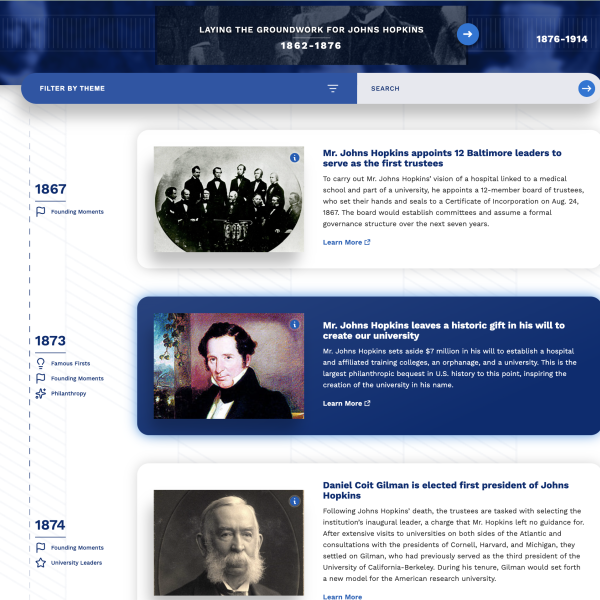
Timeline
From its earliest business classes in 1916 to the school’s official founding in 2007, Carey’s history reflects the Johns Hopkins legacy of research, innovation, and excellence. Under today’s leadership of Dean Alex Triantis, Carey continues to build on its commitment to business education through expanding degree programs, experiential learning, and a growing presence in Baltimore and Washington, D.C.
For a closer look at the history of business education at Johns Hopkins University, explore the Johns Hopkins 150 Years of Discovery and Impact timeline.