
In a milestone moment for both participants and program leaders, the Johns Hopkins Carey Business School recently celebrated the first graduating cohort of the Veterans to Executives Transition Academy, or VET Academy—an intensive, first-of-its-kind program designed to help senior military leaders successfully transition into civilian executive roles.
The ceremony marked not only the culmination of a rigorous 10-day experience but also the beginning of a new chapter for 14 accomplished leaders ready to apply their skills in new ways. Surrounded by faculty, supporters, and fellow veterans, the graduates reflected on a journey that blended personal transformation, professional development, and a renewed sense of purpose.
A program with a mission
VET Academy was created with a clear mission: to bridge the often-challenging gap between military leadership and civilian executive life. Developed by those who understand that transition firsthand, the program is rooted in practical, experience-based learning.
“This has been one of the greatest challenges of my career thus far,” said Erik Helzer, associate professor of practice in Management and Organization and the program’s academic leader. “How do you create an experience and a curriculum that does justice to these folks who are so selfless, devoted, and accomplished?”
Helzer’s vision for the program began during his time as a faculty member at the Naval Postgraduate School, where he worked closely with military leaders. When he returned to Carey, he saw an opportunity to build something new—something that would equip veterans not just to enter the civilian workforce, but to thrive at the highest levels.
To bring that vision to life, he partnered with Brandon Smart, a retired first sergeant in the United States Marine Corps, whose own transition experience guided the program’s design.
“Having recently transitioned out of the Marine Corps, I understand how challenging it can be to navigate the shift into a civilian executive role, even with years of leadership experience,” said Smart. “Being part of the team shaping the VET Academy has been meaningful work.”
Smart contributed through extensive interviews with fellow veterans, employers, and subject matter experts, helping ensure the program addressed real-world challenges—from translating military experience into business language to building confidence in unfamiliar environments.
“It’s an opportunity to build a community and curriculum that meets veterans where they are and helps them take confident next steps,” he said.
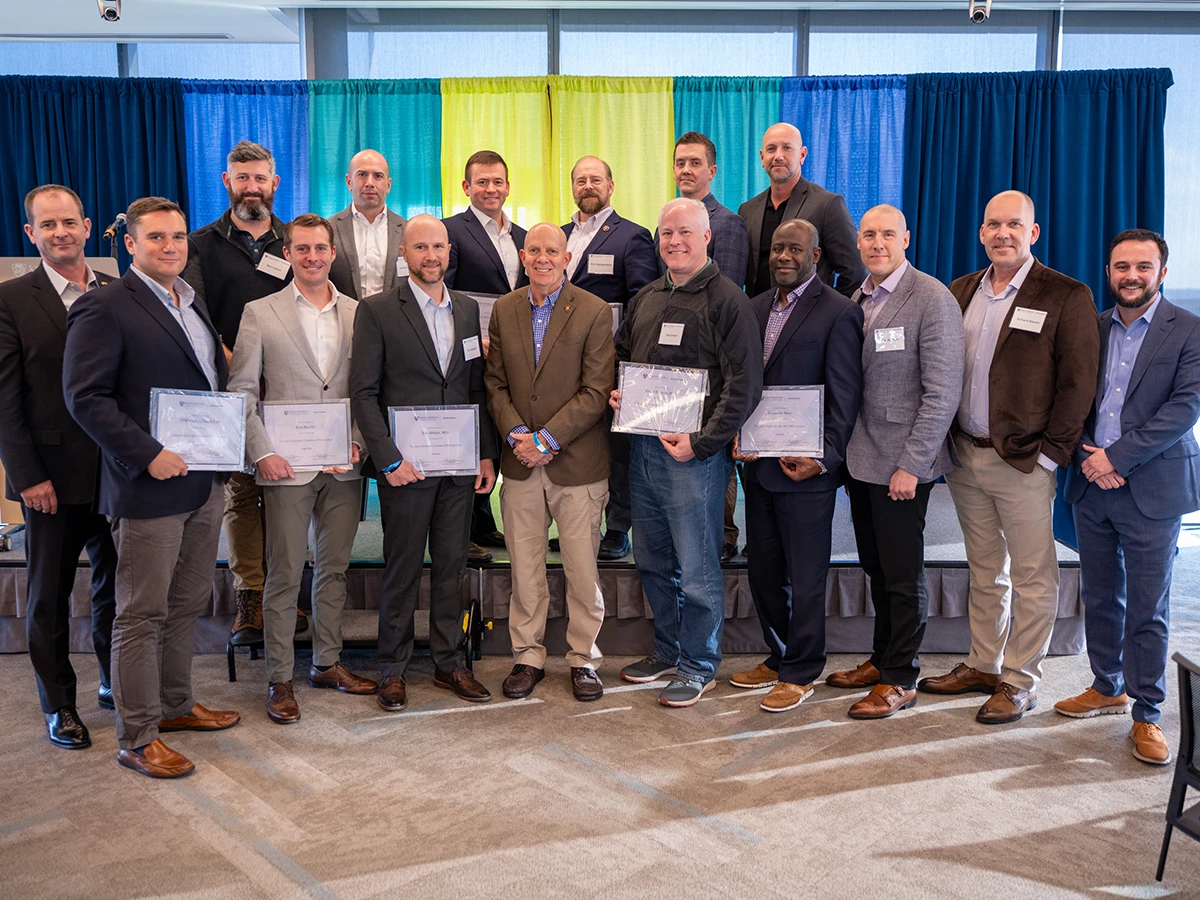
An immersive, high-impact experience
VET Academy is intentionally intensive. Over the course of 10 days, participants engage in a carefully designed curriculum built around three core pillars: academic instruction, executive coaching, and networking with industry leaders.
The structure reflects the program’s goal of delivering immediate, actionable value. Participants don’t just learn concepts—they apply them in real time, gaining tools and perspectives they can carry directly into their next roles.
For the inaugural cohort, that experience was made possible in part through strong community support. Approximately $60,000 in donations helped offset costs, enabling participants to attend the program at a significantly reduced rate, with lodging and meals included.
But beyond logistics, what stood out most was the collaborative spirit behind the program’s development.
“Everything has come together in an almost serendipitous way,” Helzer said. “You tell people what we’re doing here, and they say, ‘How can I help?’”
Associate Vice Provost and Director of Athletics and Recreation at Johns Hopkins University, Jen Baker—who is also a Navy veteran—was eager to support VET Academy. She arranged for the cohort to attend the Navy/Hopkins lacrosse game, which provided valuable community-building time and ended in a Hopkins win.
That enthusiasm extended across Johns Hopkins, with partners such as the Pava Marie LaPere Center for Entrepreneurship and the Applied Physics Laboratory contributing to the program’s ecosystem. Helzer hopes to continue building on that momentum.
“In the future, we’ll continue to bring in all the incredible resources across Hopkins to create a real center of energy that works in tandem with our cohort’s entrepreneurial spirit,” he said.
Leadership lessons for the next chapter
A highlight of the closing ceremony was the keynote address delivered by retired General David Berger, the 38th commandant of the U.S. Marine Corps, and a 2005 graduate of Johns Hopkins University’s School of Advanced International Studies. Drawing on decades of leadership experience, Berger offered graduates a candid and practical roadmap for navigating their transition.
He emphasized that success in civilian life requires many of the same qualities that define strong military leaders—along with a willingness to adapt.
Among the most critical traits, he noted, are grit and resilience.
“We learn from setback and bloody noses,” Berger said, underscoring the importance of persistence in unfamiliar environments.
He also pointed to the growing importance of soft skills, including communication, empathy, and active listening—capabilities that become increasingly essential at the executive level.
“Don’t confuse being humble with a lack of confidence,” he added, encouraging graduates to balance self-assurance with openness to learning.
Berger highlighted additional qualities that distinguish those who transition successfully: integrity, a sense of humor, and the ability to surround themselves with people who are both capable and willing to challenge them.
He also urged graduates to remain grounded in their values.
“Never forget where you came from,” he said, encouraging them to mentor others and pay forward the support they’ve received.
Finding opportunity in uncertainty
Throughout his remarks, Berger returned to a central theme: the importance of adaptability in a rapidly changing world. He encouraged graduates to embrace uncertainty rather than avoid it, noting that some of the greatest opportunities emerge in moments of disruption.
“Inside the chaos is opportunity, if you can find it,” he said.
That mindset—paired with the ability to make decisions with incomplete information—is one that many veterans already possess. The challenge, he noted, is learning how to translate those instincts into a civilian context.
Listening, too, remains a critical skill.
“Get better at it as you get more senior,” Berger advised, reinforcing the idea that leadership is as much about understanding others as it is about directing them.
He also reminded graduates to prioritize what matters most beyond their careers, including family and personal well-being—an essential foundation for long-term success.
A deeply personal milestone
For many in attendance, the ceremony was more than a professional achievement—it was a deeply personal moment.
Among the special guests was Sonya Arrington, a Carey alumna and the daughter of one of the original Tuskegee Airmen. Supporting veterans has long been an important part of her life, and she described the event as a meaningful convergence of her personal and professional experiences.
Her time at Carey, she said, was “monumentally defining,” and witnessing the launch of the VET Academy—and the success of its first cohort—was especially significant.
Seeing those worlds come together, she added, was “the best thing that ever happened.”
Building a lasting community
While the ceremony marked the end of the program, it also signaled the beginning of an ongoing network.
One of the VET Academy’s core goals is to foster a strong sense of community among participants—one that extends well beyond their 10-days together. Through shared experiences and continued engagement, graduates become part of a growing ecosystem of leaders supporting one another’s success.
That emphasis on connection is intentional. Transitioning from military to civilian life can be isolating, even for the most accomplished leaders. By creating a built-in network, the program helps ensure that participants don’t navigate that journey alone.
For Smart, that sense of community is one of the program’s most meaningful outcomes.
“I’m looking forward to seeing the impact the program will have on [the first cohort’s] transition journeys, and watching them go on to lead with purpose in their next chapter,” he said.
Looking ahead
As the first cohort steps into new roles and opportunities, the VET Academy is already looking toward the future.
Applications are now open for upcoming cohorts, and program leaders are continuing to refine and expand the experience based on early feedback and growing interest.
For Helzer, the long-term vision is clear: to establish the VET Academy as a premier pathway for career military leaders transitioning into civilian executive roles—and to continue building a program that reflects both their achievements and their potential.
Ultimately, the success of the program will be measured not just by what happens during those 10 days, but by what graduates go on to accomplish afterward.
If the inaugural cohort is any indication, that impact is just beginning.


